by Daniel Fink, MD, Chair, The Quiet Coalition
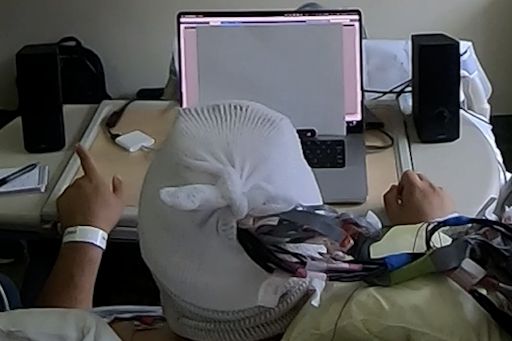
Photo Credit: Vishal Choudhari / Mesgarani lab / Columbia’s Zuckerman Institute
Can brainwave-guided hearing aids be developed? That’s the possibility suggested by researchers at Columbia University in New York in a recently published paper in Nature Neuroscience and summarized here.
The researchers used high-resolution electroencephalography (EEG recordings) to guide a brain-computer interface (BCI) to help the four subjects undergoing high-resolution intracranial EEG monitoring for epilepsy focus on one conversation or another in a simulated noisy environment.
As their paper notes, three complementary experiments "significantly improved speech intelligibility, reduced listening effort, and was consistently preferred over the baseline….[T]his work moves brain-controlled hearing from theoretical promise to validated technology…establishing a critical performance and viability benchmark that confirms the fundamental promise of auditory BCIs and laying the foundation for next-generation assistive and augmented listening technologies.”
I’m not certain how high-resolution EEG recordings will be used to guide hearing aids to focus on one conversation among many in a noisy restaurant, or when this technology will become commercially available. Until that day, why not just make it easier for people with hearing loss to converse with their dining companions by reducing the ambient noise level in restaurants? Some modifications to reduce restaurant noise are costly, but turning down the volume of background music amplified to rock-concert sound levels doesn’t cost anything.
Quieter restaurants, as part of a quieter world, will be a better and healthier world for all.