
What is otoaging?
by Daniel Fink, MD, Chair, The Quiet Coalition
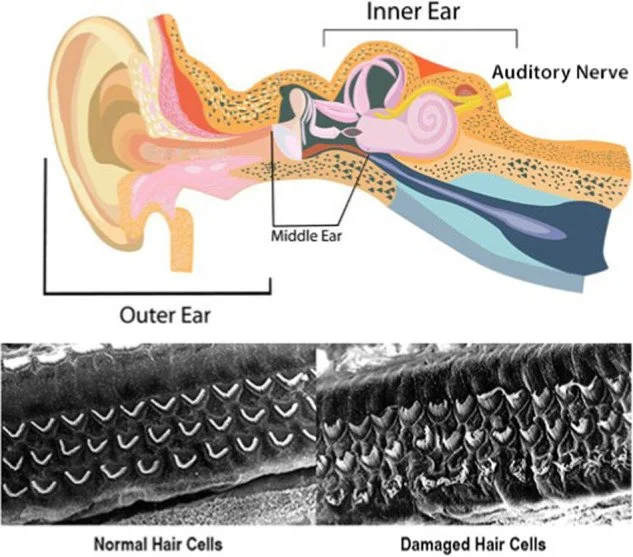
Photo Credit: Centers for Disease Control and Prevention
What is otoaging? As I explain in the title of my latest publication, “Age-related hearing loss is really otoaging, noise-induced hearing loss in elderly persons.” Otoaging is a neologism, a new word that I created to describe both the premature aging of cochlear hair cells and synapses caused by noise, and the end result, hearing loss in old age. I was inspired by the term photoaging, used by dermatologists to describe the premature aging of the skin by sun or ultraviolet light exposure, and the end result, deeply wrinkled and pigmented skin. Decades ago, a few noise researchers used the neologism sociocusis to describe the hearing loss caused by noise exposure in everyday life, but that term did not catch on. I hope mine does.
Why does this matter? If hearing loss in old age is part of normal physiological aging, like thinning, graying hair, nothing can be done to prevent it. But if age-related hearing loss is really the cumulative effect of a lifetime of excessive noise exposure on the ears, reducing noise exposure beginning early in life should preserve normal hearing into old age. The only treatments available for noise-induced hearing loss are amplification with hearing aids, or cochlear implants. Both treatments are costly, and neither restores normal hearing. Unlike eyeglasses or contact lenses, which provide a visual correction, hearing aids merely deliver an amplified sound wave to dead or dying cochlear hair cells (see illustration), which does not provide an auditory correction.
In the last few decades, many conditions or diseases once thought to be an inevitable part of normal aging have been shown to be largely preventable by changes in diet, exercise, or reducing exposures to sun or cigarette smoke. Among these are obesity, muscle weakness, Type II diabetes, hypertension, heart disease, dementia, and lung and skin cancers. Otoaging should be added to this list. One might consider otoaging to be a disease of civilization, caused by the changes in our world due to modernity, in this case the noisy life people live in industrialized societies.
The World Health Organization appears to understand that excessive noise exposure is the major cause of hearing loss, estimating that 1.1 billion young people are at risk of losing their hearing from use of personal listening devices or attending dance clubs or rock concerts. When these young people reach old age, they will almost assuredly have what is now called Age-Related Hearing Loss, which is really otoaging, largely preventable noise-induced hearing loss in older individuals due to a lifetime of excessive noise exposure.
Yes, just about everything gets worse with age, some things a little and some a lot. But if I’m wrong about what causes hearing loss with old age - if there is any published research showing that significant hearing loss meeting the World Health Organization’s 25 decibel level is indeed caused by normal physiological processes, or by nutritional, vascular, genetic factors, or use of ototoxic drugs, I ask that someone show me those articles. I haven’t been able to find them.
Preventing noise-induced hearing loss is simple and inexpensive. If something sounds loud, it’s too loud, and one’s auditory health* is at risk. Turn down the volume, leave the noisy environment, or use hearing protection, and one’s ears should last a lifetime.
*Auditory health includes protecting hearing but also avoiding tinnitus (ringing in the ears) and hyperacusis (a sensitivity to loud noise that doesn’t bother others). There are no published studies of the noise dose required to develop tinnitus or hyperacusis, but reducing noise exposure to prevent noise-induced hearing loss will probably also reduce the likelihood of developing these two other auditory conditions.