
What 311 noise data tells us
by Jeanine Botta, MPH, Co-founder, The Quiet Coalition
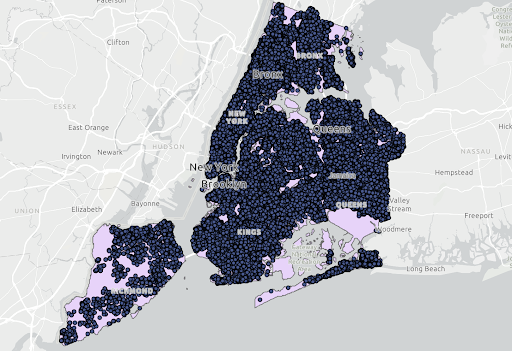
Photo credit: Noise Complaints New York City 2025
Every year or so, a news article will report on New York City noise levels for the previous year, usually identifying the loudest neighborhoods. An article about 2025 noise levels cited Community District 12 in The Bronx as the loudest, with Flatbush, Brooklyn in second place. The placement on the “loudest” list may or may not be accurate, because the reporting is based on data from NYC311, the city’s non-emergency service request line, and 311 is better at measuring noise complaint behavior than it is at measuring noise levels.
Other factors that can make one neighborhood appear to be louder than others include multiple residents reporting a party or other loud event, or residents soliciting 311 noise complaints on social media for a given location, regardless of the actual location of those reporting.
My neighborhood, East Flatbush, shares a border with Flatbush, and is easily among the loudest anywhere in New York City. It has never been listed among the loudest, and probably never will be since East Flatbush residents rarely submit noise complaints to 311. On the other hand, I have attended NYPD sector meetings in my own precinct sector and in neighboring sectors where individuals and groups complained about a specific neighbor or group creating disruptive noise.
Noise complaint behavior is complicated, and in some ways, it hasn’t changed in decades. According to the research (1961) of Paul N. Borsky, who studied noise complaint behavior, reasons for not complaining included concerns about complaints being ineffective, and concerns about what others would think if one complained, such as thinking that complaining about noise was inappropriate. The research of George A. Luz and colleagues (1983) found that noise complaints were not an accurate measure of being adversely affected by noise, a number that researchers thought to be much higher than noise complaints seemed to indicate.
Today people may have concerns similar to those in the sixties, seventies, and eighties, as well as newer concerns about being perceived as oppressors for reporting disruptive noise.
New York City officials have plans to address overall high levels of noise by expanding the noise camera program from 11 cameras to 25, with five devices in each borough. But noise camera placement is decided based mostly on the number of 311 complaints for a given area.
This plan does not seem adequate. Adding noise cameras should be part of a more complex plan, involving many more devices, and involving camera placement in rotating locations.
Decisions about placement should go beyond using 311 complaint data. Community surveys, sound walks, and use of alternative sound level measurement devices could be effective in determining which areas need attention, rather than relying on a system that mainly measures complaint behavior. Measurement of sound levels, including traffic noise levels, might also be accomplished using noise monitoring devices that are now being used to monitor construction site sound levels.
Education should also be included as an important part of a comprehensive plan to address noise. Some professional drivers working in East Flatbush will argue that horn honking for reasons other than imminent danger is not illegal – because “No Honking” signs were taken down. Educational programs about noise ordinances and the health impacts of noise can be a creative, positive, and engaging experience.